The Oral Section of the Canadian Physiotherapy Examination (CPTE) carries 150 of the exam's 250 points — 60% of your total. It is the section where well-prepared candidates pull ahead and where under-prepared candidates fail an otherwise winnable exam. Most Internationally Educated Physiotherapists understand the Written section instinctively but treat the Oral as an abstract risk. This guide gives you the actual structure and what examiners are listening for.
All structural facts in this article are sourced from the official CAPR Candidate Guide: Canadian Physiotherapy Examination — Candidate Guide.
The structure in one paragraph
The Oral Section is a 2.5-hour structured case-based assessment composed of 10 cases. For each case, you are provided in writing with the context of a clinical encounter and a set of questions. You then respond verbally to examiners. Your responses across all 10 cases are scored against the competencies CAPR has defined for safe, effective, independent physiotherapy practice in Canada.
That is the entire format. There is no surprise station, no physical performance task with a patient, no equipment to operate. The exam tests your reasoning and how clearly you can communicate it under time pressure.
What examiners are listening for
CAPR defines the competencies assessed by the CPTE explicitly. From their materials, these include:
- Clinical reasoning and decision-making — assessment and diagnosis, care planning
- Client-centred care and safety
- Communication
- Collaboration
- Professional responsibilities
- Practice management
Source: CAPR — Canadian Physiotherapy Examination.
For the Oral Section specifically, this means examiners are not scoring whether you know the most facts. They are scoring whether you can think clearly about a patient, prioritize safely, and communicate your thinking in a structured, defensible way. The competencies are weighted into your overall score; individual question marks roll up into your case score, and case scores roll up into your section score.
The single most useful reframe
Stop thinking of the Oral as "talking about cases." Think of it as clinical reasoning made audible. The examiner cannot read your mind. If your reasoning is correct but you stumble, contradict yourself, or jump between thoughts, the score reflects what you said — not what you knew.
This is the part that catches IEPTs whose home-country exams tested content recall. Knowing the right answer is necessary but not sufficient. You have to structure the right answer out loud in a way the examiner can follow.
A defensible answer structure that works for almost any case
You do not need a different framework for every case type. One reliable structure handles assessment cases, treatment cases, discharge planning, and most communication scenarios:
- Safety screen first — vitals stable, no red flags, no urgent escalation needed. Even one sentence acknowledging you considered safety scores points and prevents losing them.
- Clarify the question — "I am being asked to..." restate it in one sentence. Forces you to focus and gives examiners confidence you understood.
- State your working hypothesis or priority — "Based on this, my primary working diagnosis is..." or "My priority for this session is..."
- Justify with two or three findings — pull specific data from the vignette to support your reasoning. Specific is better than thorough.
- State your plan — what you will do next, in concrete terms (assessments, treatment progressions, referrals, education).
- Mention reassessment — "I would reassess [specific outcome measure] after [interval] to confirm progress."
That structure is roughly 90 seconds spoken at a normal pace. It fits inside almost any single Case Question.
What examiners reward
Three things, repeatedly:
Specific over general. "I would treat" is weaker than "I would use task-specific gait training with treadmill support at 40% body weight unloading, 30 minutes, 3 days per week, with progression based on overground 10-metre walk test." Specific dosage and reassessment markers signal you have practiced the reasoning, not just read about it.
Safety language used naturally. Mentioning vital sign monitoring, escalation criteria, contraindications, and red flag screens — without being prompted — signals competent practice. These phrases should be in your spoken vocabulary, not pulled in at the end as an afterthought.
Reasoning over recall. When you do not know a precise fact, naming your reasoning is better than guessing. "I would confirm this with [specific imaging or test], but my working hypothesis based on the presentation is..." scores better than a confident wrong answer.
What examiners penalize
Three patterns that lose points more than candidates realize:
Contradicting yourself within an answer. "I would mobilize the patient... but actually I would keep them on bed rest." Examiners hear this as confused reasoning. If you change your mind, say so explicitly: "On reflection, I would change my answer to..." It is better than drifting between contradictory positions.
Listing without integrating. Naming five assessments without saying which one you would prioritize and why is worth fewer points than naming two and integrating them. The Oral tests judgement, and judgement requires choosing.
Talking past the question. Examiners ask specific things. If the question is "what is your most appropriate initial assessment?" the answer is one assessment, briefly justified — not a five-minute walk through your entire patient interview. Listen to the question, answer the question.
How to prepare in the four weeks before your exam
Preparation for the Oral is unlike preparation for any other section. Reading does not work. Watching videos does not work. Only one thing works reliably:
Verbalize cases out loud, on a clock, with someone listening or with recording.
A practical weekly structure:
- Monday and Thursday: Pick one case from your question bank. Read the vignette once. Set a timer for 90 seconds per question. Speak your answer out loud, recording on your phone. Three questions per case = ~5 minutes spoken.
- Tuesday and Friday: Listen back to the recordings from the previous session. Note where you hesitated, contradicted yourself, or talked past the question. Write one sentence on what to change.
- Saturday: Full mock oral — 3 cases back to back with no notes, recorded. Review afterwards.
- Sunday: Off, or light content review on whichever competency emerged as weakest.
Four weeks of this routine builds verbal fluency that no amount of reading produces. The first week feels terrible. The fourth week feels markedly different.
The two mistakes IEPTs make most often
After working with IEPT candidates, two failure modes dominate the Oral:
Trying to memorize "what to say." Examiners can tell instantly. Memorized answers fail because real cases are too specific to recite from a template. The competency is verbal clinical reasoning, not verbal recall.
Avoiding mock orals because they feel uncomfortable. The discomfort is the point. Mock orals are the diagnostic — they surface exactly the verbalization gaps you need to close. Candidates who delay mocks because they "don't feel ready" arrive at exam day still not ready, having missed the only practice that mattered.
What to do this week
Open the oral exam practice in your question bank, pick one case at random, set a phone-timer for 5 minutes, and verbalize a complete clinical reasoning response out loud. Record it. Listen back. That single five-minute exercise will tell you more about your readiness for the Oral Section than another hour of reading the Competency Profile.
The Oral feels intimidating because it is unfamiliar, not because it is harder than the Written. Once you have completed ten or so cases out loud, the format becomes routine. Most IEPTs who fail the 2026 exam fail because they did not practice this routine enough. Most IEPTs who pass did.
Practise with AI examiner feedback
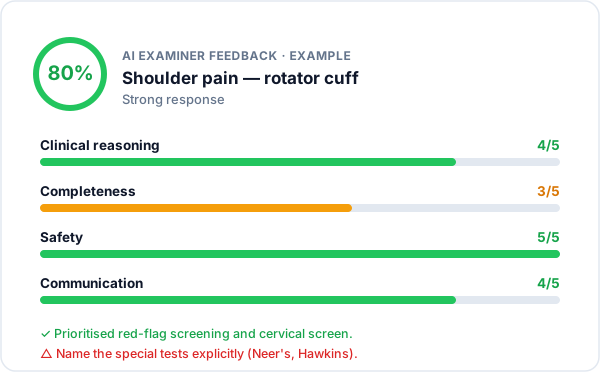
PhysioExamPrep includes 40+ structured CPTE-format oral cases. Record your spoken response and get an AI examiner rubric — scored on clinical reasoning, completeness, safety, and communication, with specific strengths and gaps — so you can see exactly where the marks are won and lost. You can try it free on one full case.
Related reading: CPTE oral exam: format, scoring & how to prepare · How to handle the CPTE oral exam's clinical reasoning stations · The 2026 CPTE format, scoring & pass standard