The CPTE Oral section accounts for 150 of the exam's 250 total points, making it the higher-weighted component. Yet most IEPT preparation plans allocate the majority of study time to the Written section. The result is a predictable pattern: candidates pass the Written by a reasonable margin and are surprised when the Oral is harder than expected.
This guide explains how the Oral section works in 2026, what examiners score you on, and the specific techniques that produce strong performance in the clinical reasoning stations.
How the 2026 CPTE Oral section is structured
The Oral section runs for 2.5 hours and is delivered virtually. It consists of structured clinical stations — case-based scenarios where you interact with a standardized patient, a simulated colleague, or an examiner in the role of an assessor or clinical educator.
Each station presents a clinical scenario. You are expected to demonstrate: clinical assessment, clinical reasoning, communication, patient-centred care, professional judgment, and — in some stations — interprofessional collaboration. Not every station tests every competency, but across the full session all seven CanMEDS-PT roles are assessed.
The 2026 CPTE maps stations against the CanMEDS-PT framework:
- Expert: clinical assessment and intervention reasoning
- Communicator: how you speak with and listen to the patient or family
- Collaborator: when and how you involve other professions
- Manager: documentation, time and resource management
- Health Advocate: recognizing and addressing barriers to patient care
- Scholar: applying evidence to clinical decisions
- Professional: ethical judgment and self-regulation
Most stations are primarily testing Expert + Communicator, with Collaborator and Professional as secondary layers. The stations that catch candidates off guard are the ones that emphasize Communicator, Collaborator, or Professional when you expect them to test Expert only.
What examiners score — and what they don't
Examiners in Oral stations use structured scoring rubrics. They are not scoring your medical knowledge vocabulary. They are scoring specific, observable behaviours:
High-scoring behaviours:
- Greeting the patient by name, introducing yourself and your role, and confirming consent before beginning
- Asking open-ended questions first, then narrowing to specific closed questions
- Using plain language with the patient and shifting to clinical language only when speaking to the examiner
- Summarizing your findings back to the patient before moving to the next step ("Based on what you've told me, I'm hearing that...")
- Explicitly naming your clinical reasoning ("I'm concerned about X because...")
- Identifying when to refer and naming the referral destination specifically
- Asking about the patient's goals and expectations before proposing a treatment plan
Low-scoring behaviours:
- Beginning assessment without introductions or consent
- Using jargon with the patient ("Your ACJ is mildly subluxed with a positive cross-body")
- Launching into a monologue of clinical knowledge without patient interaction
- Missing red flags entirely or acknowledging them but not acting on them
- Proposing a treatment plan that does not address the patient's expressed goals
- Failing to address the patient as a person (name, emotional tone, validating their concern)
The most commonly cited reason for Oral failure is not insufficient clinical knowledge — it is failure to demonstrate person-centred communication. You can know everything about the clinical content and still fail a station by talking at the patient rather than with them.
The station opening — where most marks are won or lost
Standardized patients in Oral stations follow a script. They respond to what you ask, how you ask it, and whether you seem genuinely engaged with them as a person. Examiners observe the first 60–90 seconds closely.
A strong station opening follows this sequence:
- Introduce yourself: "Hello, my name is [Name], I'm a physiotherapist here today. Can I confirm I'm speaking with [Patient name]?"
- Confirm consent: "I'd like to assess your [condition/body part] today. Have you been told what we'll be doing, and are you comfortable to proceed?"
- Open with their words: "Can you tell me, in your own words, what's brought you in today?" — then stop and listen fully without interrupting
- Acknowledge the concern: "Thank you for telling me that. I can hear that [pain / difficulty walking / concern about your recovery] has been really affecting you."
- Signpost the session: "I'm going to ask you some questions about your history and then assess your [relevant area]. At any point if something is uncomfortable or you have questions, please let me know."
This takes approximately 90 seconds. It does not "waste time." Examiners expect it, and its absence immediately signals a Communicator deficit.
Clinical reasoning in station cases — the structure that works
Once you are into the body of the station, your reasoning needs to be visible and organized. Examiners cannot score what they cannot observe. The structure below applies to most assessment and management stations:
Step 1 — Hypothesis generation: From the opening history, generate 1–3 differential diagnoses silently. Do not announce them yet — gather more information first.
Step 2 — Directed assessment: Systematically test your hypotheses with targeted assessment. Name what you are looking for and why: "I'm going to test your shoulder flexion range of motion to check for a capsular pattern that would be consistent with adhesive capsulitis."
Step 3 — Safety screen: Before any assessment that involves movement, screen for red flags relevant to the body area. In MSK: neurological signs, vascular compromise, systemic red flags. In neuro: cognitive status, fall risk, skin integrity. This is not just checkbox behaviour — it signals clinical judgment.
Step 4 — Clinical reasoning statement: After completing your assessment, summarize clearly: "Based on my findings — the insidious onset, the capsular pattern restriction, and the firm end-feel in all planes — my primary hypothesis is adhesive capsulitis rather than a rotator cuff tear, because a tear would typically produce weakness on resisted testing rather than global restriction."
Step 5 — Patient-centred goal-setting: "Before I share what I'd recommend, can I ask what's most important to you in terms of your recovery? What would getting back to feeling well mean for you?" This is not a formality — it is a scored behaviour that reflects whether your management plan will be individualized.
Step 6 — Management plan: Propose a plan grounded in your assessment and the patient's goals. Name the evidence for your approach. Include referral or interprofessional consultation if indicated.
Handling the unexpected — probes, complications, and redirects
Examiners will introduce complications mid-station. A standardized patient will disclose something you did not expect (financial difficulty getting to appointments; a family member who disagrees with the treatment plan; a new symptom that changes the clinical picture). A station may pivot from physical assessment to a difficult conversation.
When a complication arises:
- Pause before responding (a 2–3 second pause is not a weakness; it signals that you are thinking)
- Acknowledge the new information: "Thank you for telling me that. This changes some of my thinking."
- Reason aloud: "Given that you're also experiencing [new symptom], I'm now more concerned about [differential]. Here's what I think we should do..."
The examiners are not trying to trick you into failure. They are testing whether you can adapt — whether your clinical reasoning is flexible, not scripted.
The Communicator role: what it specifically means in practice
The most underrepresented preparation area for IEPTs is the Communicator role. In international training contexts, the patient interaction component of clinical education is often less formally assessed than technical skills. In the CPTE, it is scored explicitly.
Communicator role behaviours the CPTE scores:
- Using teach-back when giving patient education ("Can you tell me in your own words what we've agreed you'll do at home?")
- Checking understanding before moving to the next topic
- Responding to emotional cues ("I can see this news is difficult to hear")
- Using appropriate body language (in a virtual setting: eye contact with camera, not screen; engaged posture)
- Explaining prognosis honestly and accurately, without false reassurance or unnecessary alarm
The most useful preparation technique for the Communicator role: record a 5-minute mock station and watch the recording. (In the PhysioExamPrep Oral module you can record your response to a real CPTE-format case and get an AI examiner rubric on your reasoning, safety, and communication.) You will see your communication patterns clearly. Most people say "okay" and "right" after patient statements without genuinely engaging. The Oral section requires genuine engagement.
Preparing for the Oral — the six-week plan that works
With six weeks available before your Oral section:
- Weeks 1–2: Learn the station structure. Do 2–3 mock openings per day, just the introduction and history-taking. Focus entirely on the first 90 seconds.
- Weeks 3–4: Add the assessment and reasoning components. Do full mock stations with a study partner or in front of a mirror. Ensure clinical reasoning is audible — say it, do not just think it.
- Week 5: Work on the specific station types you find most difficult (communication-heavy cases, ethical scenarios, multi-morbidity cases). Record yourself. Identify one specific improvement per session.
- Week 6: Full mock Oral under timed, virtual conditions. Treat it as the real exam. Review the recording for Communicator, Collaborator, and Professional role gaps specifically.
The Oral section is a skill that improves with deliberate practice. Unlike clinical knowledge, which plateaus once you know a fact, communication under observation continues to improve through repetition.
Practise oral cases with AI examiner feedback
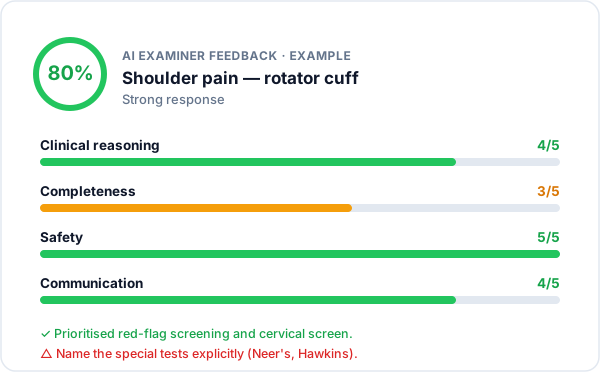
Reading about the Oral section is not enough — it is a performance skill that improves only with reps under observation. PhysioExamPrep includes 40+ structured CPTE-format oral cases with model answers and probe questions. Record your spoken response and get an AI examiner rubric — scored on clinical reasoning, completeness, safety, and communication, with specific strengths and gaps — mirroring how real examiners assess you.
Here is what the feedback looks like on a real case:
You can try the AI examiner free on one full case before upgrading. Start the Oral module at least 8 weeks before your exam date.
Related reading: CPTE oral exam: format, scoring & how to prepare · What CPTE oral examiners actually score you on · The 2026 CPTE format, scoring & pass standard
Sources: CAPR CanMEDS-PT framework (2025); CAPR Oral Examination Guide.