The CPTE oral exam carries 150 of the Canadian Physiotherapy Examination's 250 points — 60% of your total score, and more than the Written section. Yet most Internationally Educated Physiotherapists (IEPTs) spend the majority of their preparation on the Written and treat the oral as an abstract risk. That imbalance is the single most common reason otherwise well-prepared candidates are caught off guard.
This guide is the complete picture of the CPTE oral exam in 2026: how it is structured, how examiners actually score you, the competencies it tests, and how to prepare. For deeper dives, it links to focused guides on handling the clinical reasoning stations and what examiners score you on.
What the CPTE oral exam is
The oral exam (the Oral Section of the CPTE) is a 2.5-hour, virtually delivered, structured case-based assessment made up of 10 cases. For each case you are given, in writing, the context of a clinical encounter and a set of questions. You then respond verbally, in real time.
It is not a recall test. The written prompt gives you the scenario; the marks come from how you reason out loud — assessment, clinical decision-making, safety, and communication — under observation.
How the CPTE oral exam is scored
- 150 points total — 15 points per case, across 10 cases. Your scores across all cases combine with the 100-point Written Section for a single total out of 250.
- Two examiners evaluate each response. At least one scores you live as you speak; if a second live examiner is not available, they score from a recording of your exam.
- A standardized response key is used for every case. It has two parts:
- Checklists — a list of acceptable responses to each question; the examiner checks off what you actually say.
- Performance scales — a rating of how well you explain your clinical reasoning and decision-making, and how effectively your response addresses the intent of the question.
- The pass standard is criterion-referenced. CAPR does not publish a fixed percentage cut-score; the standard is set by a panel of Canadian physiotherapists, and the Written and Oral are judged together as a single combined pass/fail — there is no separate oral pass mark.
The two-part key is the key insight: the checklist rewards coverage (did you mention the red-flag screen, the special test, the referral?) and the performance scale rewards reasoning quality (did your answer actually make clinical sense and address the question?). You need both. A candidate who lists facts without reasoning, or reasons vaguely without covering the expected content, leaves marks on the table.
The competencies the oral exam tests
Every case is mapped to the competencies CAPR has defined for safe, effective, independent physiotherapy practice in Canada — the seven domains that also structure the Written section:
- Assessment & diagnosis
- Client safety
- Care planning & intervention
- Communication
- Collaboration
- Professional responsibilities
- Practice management
Not every case tests every domain, but across all 10 cases the full set is assessed. The stations that surprise candidates are the ones that emphasise communication, collaboration, or professional responsibility where you expected a pure clinical-assessment case.
Why IEPTs underestimate the CPTE oral exam
Two patterns show up again and again:
- Treating it as a knowledge test. The oral exam assesses verbal clinical reasoning, not recall. Memorised, templated answers fail because real cases are too specific to recite — and examiners can tell instantly.
- Under-practising person-centred communication. In many international training contexts the patient-interaction component is assessed less formally than technical skill. In the CPTE it is scored explicitly, and failure to demonstrate it is the most commonly cited reason for oral underperformance — you can know the clinical content cold and still lose marks by talking at the patient rather than with them.
How to prepare for the CPTE oral exam
The oral exam is a performance skill. Like any performance skill, it improves only with repetition under observation — not with more reading.
- Practise out loud, on a timer, from written prompts — mirroring the real format. Record yourself and review where you hesitated, contradicted yourself, or talked past the question. (See the six-week preparation routine for a structured plan.)
- Make your reasoning audible. Name your hypotheses, your safety screen, and your rationale. Examiners can only score what they observe.
- Rehearse the station opening — introduction, consent, an open question, acknowledging the concern. Its absence signals a communication gap in the first 60–90 seconds.
- Get feedback you can act on. Reviewing your own recordings surfaces communication habits; a structured rubric surfaces the reasoning and safety gaps.
Practise the oral exam with AI examiner feedback
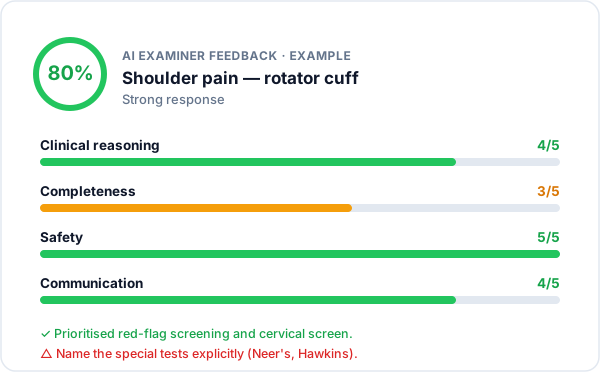
PhysioExamPrep includes 40+ structured CPTE-format oral cases with model answers and probe questions. Record your spoken response and get an AI examiner rubric — scored on clinical reasoning, completeness, safety, and communication, with specific strengths and gaps — mirroring the checklist-plus-performance-scale approach real examiners use.
Here is what the feedback looks like on a real case:
You can try the AI examiner free on one full case before upgrading. Start practising the oral exam at least 8 weeks before your exam date.
Keep reading
- The CPTE oral section: how to handle clinical reasoning stations
- The CPTE oral section: what examiners actually score you on
- The 2026 CPTE format, scoring & pass standard explained
Sources: CAPR Candidate Guide — Canadian Physiotherapy Examination (November 2025); CAPR CanMEDS-PT / competency framework (2025).